








No autonomous driving without active cooling

No autonomous driving without
active cooling
The automotive industry is in the midst of a revolution that will fundamentally change our mobility. Autonomous driving is the key concept that drives this transformation ahead. Complex technological challenges are concealed behind the pledge of these vehicles. One of the most important of them is the cooling of the electronic components.
Why is the cooling of electronic components so important?
Autonomous vehicles are equipped with an abundance of electronic components from sensors and cameras to powerful processors and control units. These units frequently operate at peak performance to process real-time data and make decisions that are of crucial importance to the safety and reliable functioning of the vehicle.
The intensive use of electronic components however, causes both considerable power loss and waste heat. If this heat is not efficiently dissipated the result can be overheating which in turn affects the performance and shortens the service life of the hardware. A reliable cooling of electronic components is therefore essential in autonomous vehicles where failures or delays can have disastrous consequences.
The challenge of confined space
Even in vehicles the available installation space is limited. It must be used efficiently to create sufficient space for all the required components without affecting the vehicle performance or the comfort.
Thanks to their compact size axial fans are the ideal solution for making efficient use of available space while maintaining a constant, optimum temperature. The small dimensions of the axial fans allow them to be easily integrated in the existing hardware without having to make significant changes to the vehicle architecture. Furthermore, they can be positioned where the cooling is urgently required – in other words directly at the hotspot.
Active cooling with
chip cooler HXB25
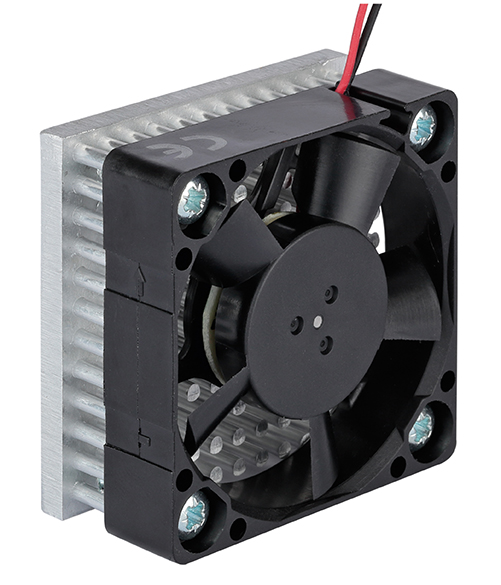
Not only due to its size is the active cooler HXB25 ideally suited for this purpose. With its dimensions of 25x25x15 mm, it is extremely small and flat and fits into the smallest of spaces. The air is suctioned from above and distributed over the heat sink with optimum dissipation.
The latest generation of coolers achieve a high volume flow rate with an extremely low power input. The HXB25 chip cooler for example achieves a thermal resistance of 3.8 k/w at a typical working current of 60 mA.
Why the noise level is so important?
Passengers, in particular in high-quality vehicles expect a quiet and comfortable driving experience. The development of noise in autonomous vehicles is therefore a critical factor. Thanks to the computer-supported development of the blade geometry of the HXB25 active cooler, it was also possible to optimize the noise development. The noise level at a typical rotor speed of 11.000 min-1 with 19 dB(A)@1 m is extremely quiet. The fan speed can be monitored by an optional tacho output that is available for each model.
The use of pulse width modulation (PWM) for controlling the fans provides an efficient method of controlling the speed and in turn the noise development of the fans. PWM-controlled fans are quiet and energy-efficient which makes them popular for use in applications where a quiet and efficient cooling is required.