








Thermal Interface Material (TIM), a thin layer with a big impact in thermal management
Technical info
Thermal Interface Material (TIM),
a thin layer with a big impact in
thermal management
High-performance electronic components generate heat. This heat must be dissipated as efficiently as possible to ensure that processors, power semiconductors, SoCs or other electronic components can operate reliably. However, the thermal interface between the electronic component and the heat sink is often underestimated.
And this is exactly where the thermal interface material, also referred to as TIM is applied. Thermally conductive materials improve the thermal contact between two surfaces and can thus significantly contribute to the optimization of the cooling performance of a system.
Why are thermally conductive materials needed anyway?
At first glance, the surface of an electronic component or the underside of a heat sink appear to be completely smooth. However, under the microscope a different picture is revealed. Both surfaces are uneven. If the two surfaces are laid directly on top of one another, there is no full contact between them due to air in the microscopically small gaps. This air gap prevents the transmission of heat between the component and the heat sink.
A thermally conductive material fills this gap and creates a significantly better thermal contact. This means that the heat can be transferred from the heat source to the heat sink more efficiently. The thermal resistance at the point of contact is reduced and the cooling solution can work more effectively.
TIM is an integral part of a well thought-out thermal management concept
The use of a suitable TIM can have an impact on the entire thermal behaviour of an electronic system.
A lower component temperature can
- Optimize the performance of the electronic components
- Reduce throttling due to temperature
- Enhance the reliability of the system
- Reduce the thermal load on the components
- Improve the lifespan of the electronic components.
What are the different types of thermally conductive materials?
A variety of materials is available depending on the application in question. They include e.g. thermal grease, thermal conductive foil, thermal pads, gap fillers or thermally conductive adhesives. Which material is most suitable depends amongst other things on the properties and dimensions of the contact surface, the required thermal transmission, the distance between the components and the mechanical requirements.
A further important question is whether the heat sink requires additional mechanical mounting or should this be simultaneously taken over by TIM? For applications where the heat sink or chip cooler need to be directly connected to the electronic components, SEPA EUROPE can provide two different solutions:
Thermal conductive foil TCT

The self-adhesive TCT thermal conductive foil creates a thermal connection between the electronic component and the heat sink while simultaneously securing it.
The foil comprises a thermal conductive acrylic backing which has an adhesive layer on both sides. Its thickness of 0.25 mm can compensate for unevenness between the contact surfaces. The thermal conductivity is 1.0 W/(m·K). The material also provides electrical insulation.
The foil is user-friendly. Simply remove the protective foil, position the thermal pad between the component and the heat sink and apply pressure.
TCT is the perfect quick, clean and space-saving mounting solution. Additional mechanical mounting elements can be renounced on depending on the application. SEPA EUROPE offers TCT thermal conductive foils not only in various standard dimensions but also customized foils on request.
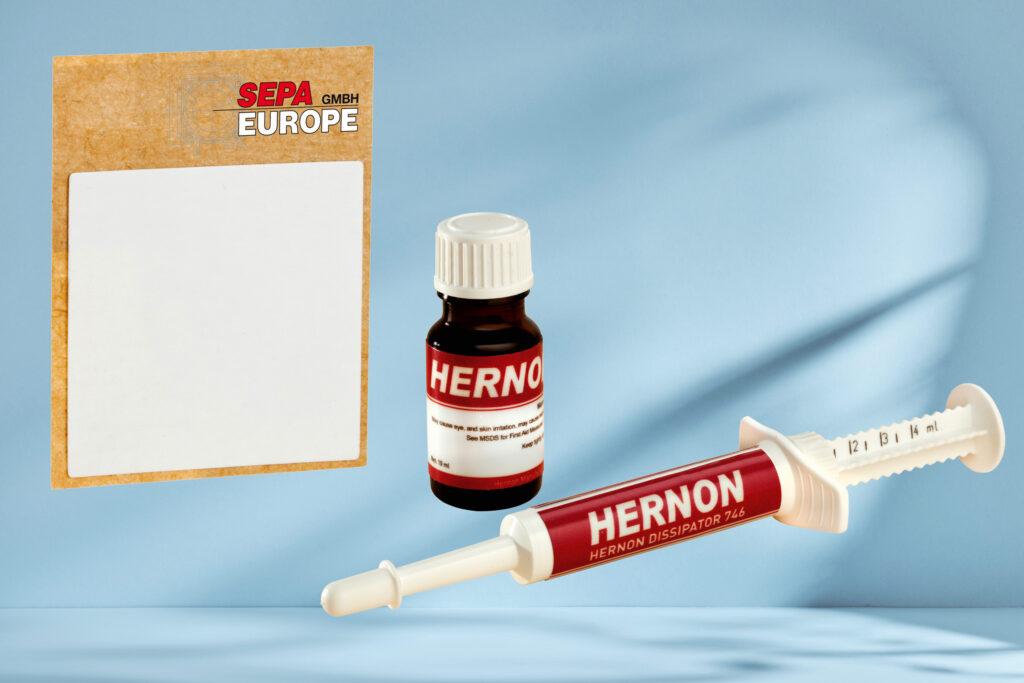
HERNON – Thermal adhesive

The thermal adhesive was specially developed for the interface between heat-generating electronic components and heat sinks or PCBs. The adhesive not only transfers heat but also has a mechanical function and provides a permanent interface between the components.
HERNON is used together with an activator. However, the adhesive and the activator are applied to the respective contact surface and not mixed with one another. The components are then joined together. Together with the corresponding activator, the adhesive reaches its initial fixing strength within a few minutes at room temperature.
TCT or HERNON? Which solution is the right one?
Which TIM solution is the best one, depends on the application in question. Discuss your thermal challenge with our specialists! SEPA EUROPE will gladly assist you with the selection and design of suitable cooling solutions.