







Quiet fans for medical devices thanks to optimized blade geometry

Quiet fans for medical devices thanks to optimized blade geometry
You can find a high-tech medical device in virtually all consultation rooms. In most of these devices fans are used for cooling the sophisticated electronics and the computer components. The noise development is not insignificant and is often experienced as unpleasant. The quieter the drives are, the better this is for the doctors, medical staff, patients and visitors. Thanks to the new fan generation LF40P by SEPA EUROPE, fan noises are a thing of the past. The optimized blade geometry ensures that the axial fans are both quiet and effective.
Medical technical products represent a special group in the wide application field of fans and cooling solutions. Whether
- X-ray machines
- patient monitors
- radiation equipment
- ventilators
- light and laser therapy devices
- DNA sequencers or
- in blood diagnostics,
fans provide reliable cooling. In the one case it may be the sophisticated power electronics where the temperature must not exceed specific values, in the other it is the cooling of the graphics editing for the high-resolution images that significantly simplify diagnostic imaging. Some of the named applications are sensitive to noise. In the diagnosis rooms for MRI, the fan noise tends to play a more subordinate role, however in the recovery room next to the patient it plays a more critical role. As the housings are becoming increasingly more compact, a large fan with low speed cannot always be realized as space is limited. Consequently, a smaller model must do the same work at high speed which in turn means an increase in noise.
With its optimized blade geometry it can combine noise and power. When compared with the similar sized previous model an increase in performance of 25% can be achieved with the identical noise level. Furthermore, the speed can be adapted to the required cooling performance via the PWM input and thus only creates the air noise that is absolutely necessary. The MagFix bearing also ensures a high shock and vibration resistance.
In medical technology, not only reliability and long service life are required, but also for example the identification of parts for logistics, documentation queries relating to individual assemblies that are required for the certification of the end product as well as a clear strategy in change management to avoid endangering the overall function of the device in the event of a necessary part change. SEPA EUROPE is the right partner with experience in medical technology!
The LF40P series – the new fan generation by SEPA EUROPE
can remedy the situation!
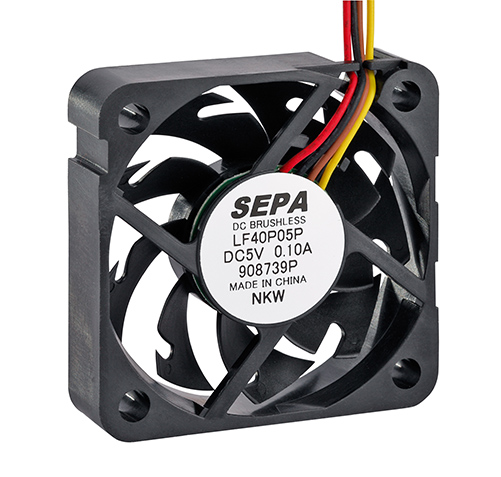
With its optimized blade geometry it can combine noise and power. When compared with the similar sized previous model an increase in performance of 25% can be achieved with the identical noise level. Furthermore, the speed can be adapted to the required cooling performance via the PWM input and thus only creates the air noise that is absolutely necessary. The MagFix bearing also ensures a high shock and vibration resistance.
In medical technology, not only reliability and long service life are required, but also for example the identification of parts for logistics, documentation queries relating to individual assemblies that are required for the certification of the end product as well as a clear strategy in change management to avoid endangering the overall function of the device in the event of a necessary part change. SEPA EUROPE is the right partner with experience in medical technology!
Noise can be reduced by up to 9dB!
Use adequately dimensioned mounting aids for reducing structure-borne noise as elastic fan sleeves. The fastening devices for elastic securing LM or SLM are available for fan sizes of 30 mm x 30 mm to 120 mm x 120 mm. They enable the quick installation on mounting plates or housings so that the noise can be reduced by up to 9dB.

In medical technology, not only reliability and long service life are required, but also for example
- the identification of parts for logistics
- documentation queries relating to individual assemblies that are required for the certification of the end product
- a clear strategy in change management to avoid endangering the overall function of the device in the event of a necessary part change.